
Researcher of the Month
February 2026
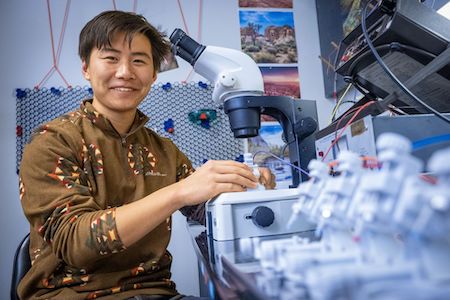 Darren Wang
Major: Biomedical Engineering; Minor: Chemistry; Class of 2026
Research Mentor: Dr. Benjamin Martin, Biochemistry & Cell Biology; Dr. Benjamin Levine, Chemistry
Link to SBU News and video feature (2/9/2026)
“ I think it's a lot of fun to be able to ideate and brainstorm with people. That's
probably what I enjoy the most. Working with other people to refine ideas and see
them come to fruition is really satisfying.” - Darren Wang, class of 2026
Darren Wang is a senior majoring in Biomedical Engineering with a minor in Chemistry whose interdisciplinary
research interests and curiosity have taken him in surprising directions as an undergraduate.
In his freshman year, he joined the research group of Dr. Benjamin L. Martin (Biochemistry
& Cell Biology), a lab which uses zebrafish to study vertebrate development. Darren
went on to develop, propose and work on a project of his own – a novel microheater
system for spatiotemporally controlling heat-shock inducible gene expression in developing
zebrafish embryos called the BOOPTHAT, with the support of a URECA summer research
grant 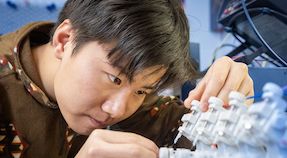 (2024). This work led to a first-author methods manuscript (2025) currently available
on bioRxiv, poster presentations at URECA symposia (May 2024 and 2025), and an oral presentation
at the Developmental Biology New York (DBNY) conference (December 2025) where Darren
was recently awarded a “best talk” award.
(2024). This work led to a first-author methods manuscript (2025) currently available
on bioRxiv, poster presentations at URECA symposia (May 2024 and 2025), and an oral presentation
at the Developmental Biology New York (DBNY) conference (December 2025) where Darren
was recently awarded a “best talk” award.
In addition, Darren’s burgeoning interest in optogenetics led him to contact Dr. Andrew Woolley at the University of Toronto and to propose a novel optogenetic transcription system actuated by two wavelengths of light, allowing improved spatial resolution of transgene activation. To support this project, Darren applied for and was awarded a MITACS Globalink grant that allowed him to spend his 2025 summer in Toronto working and developing the project; there, he also was involved in a collaboration with Dr. Mohammed Mojahedi on the idea of using holography for achieving improved spatiotemporal control. Darren is continuing to work on these projects, and together with Dr. Martin is involved in a collaborative NFRF proposal for future implementation of the holography project in the zebrafish model.
In the coming spring semester. Darren will be working in Dr. Benjamin Levine’s group to gain experience working in a theoretical chemistry lab where he will be working on exploring excited-state chemical reaction dynamics in strong laser fields. He is also currently working on his BME Senior Capstone team project on “Modular dynamic pressure redistribution platform for bedsore prevention and sleep quality improvement.” Darren is currently in the process of applying to graduate programs and plans to pursue a PhD in biophysics following graduation.
On campus, Darren is active as an Epee fencer in the University fencing club. He also has been involved in the 3D Printing Assistive Technologies for Health (3D PATH) club, and applied his skills to designing a motor-driven 3D-printed automatic dog-treat dispenser for wheelchair-bound individuals to use to interact with their service dogs (2024-present). The project is being done in collaboration with Canine Companions, a nonprofit organization working to provide service dogs to people with disabilities.
Darren is a graduate of John Jay Senior High School. A formative high school experience was his research internship at Regeneron Pharmaceuticals, in the Ophthalmology Department. Darren’s hobbies include fencing, building things, hiking, and cello. Below are excerpts of his interview with Karen Kernan, URECA Director.
The Interview:
Karen:Tell me about your research, and what you've been working on in your lab.
Darren: I’ve been working on developing tools to manipulate the timing and location of gene expression in developing embryos. I believe these types of tools will be important for furthering our understanding of animal development.
I'm in Dr. Benjamin Martin's lab, where we use zebrafish embryos as a model to study vertebrate development. We have these heat-shock inducible fish lines where transgene expression can be activated with an increase in temperature. My first project was building a microheater system that allowed us to heat up a very small part of a developing fish embryo to spatiotemporally activate those genes. This sounds a bit esoteric – “we are heating up a fish, but only in part” – but it’s important since the patterns and programs of gene expression that coordinate development are spatiotemporally regulated, and we currently lack tools for manipulating gene expression at the level of precision and complexity seen in the developing embryo.
The second project built off of the first. I eventually came to terms with the fact that the probe-based microheater system was too bulky and wouldn’t scale well, so we turned to optogenetics, which is the process of using light to control biological processes. The techniques available for spatiotemporally controlling light are super well developed and the appeal of optogenetics is getting to couple that control over light into control of gene expression. I reached out to Dr. Andrew Woolley at the University of Toronto, who works on developing optogenetic switches, and I was fortunate enough to get to spend my junior year summer with the Woolley lab to try my hand at developing optogenetic gene activation systems with improved spatial control. This was a really fun experience and I hope to continue working in this field in the future.
What are you most proud of regarding the work you've done in the lab, and what do you enjoy most about research?
I'm absolutely chuffed with the acronym I came up with for the microheater project. We call it the Batch-Operating Optically Powered Targeted Heater For Activating Transgenes, or BOOPTHAT for short. The name is a double entendre, since we are physically “booping” the embryo with the probe when we use the system. I'm also really glad that we were able to see the project through to completion. I take pride in being able to come up with interesting ideas. … I think it's a lot of fun to be able to ideate and to be able to brainstorm with people. That's probably what I enjoy the most. Working with other people to refine the ideas and see them come to fruition is really satisfying.
How did your mentor support your development on the project?
Oh, Ben's been super supportive; he was willing to provide resources and to help me develop these projects. Most importantly, he gave me the room to explore different ideas, and I'm very grateful for that. He gave me the space to explore and develop as a scientist. When I was a freshman, I really didn't know what I was doing, …it is definitely scary to put your ideas out when you have no idea whether or not they have merit. So, the fact that Ben was willing to work with me, to figure out these ideas and support them was exactly what I needed to grow. Ben's been a great mentor.
Do you see a lot of connections between what you're doing in the lab and some of the coursework that you do?
I think doing research provides a focal point, an anchor. There's a lot of information that is covered in the different classes, and it's nice to be able to say, okay, I know this is what I'm interested in, and now I can select the classes that I want to take, and shape the way I approach those classes based on my interests. It is nice to be able to build your knowledge and intuition around a research interest.
You’re also involved as a CEAS engineering student in doing senior design. What’s that experience like for you? Is it very different from your lab experience?
It is definitely different. Both share the sense of trying to do something new, which is really fun, but for the lab, there is more of an element of discovery, while senior design is more about creating a product that addresses a specific need. Also, the senior design project is more of a team-based activity while in research you often have to thug it out solo.
How do you think that the BME major has given you fresh insight into the work you do in the Martin lab?
I think having knowledge of the tools and techniques in the engineering toolkit has been very useful. A lot of my work in the lab has been engineering-esque, working on tools development. There are many open questions that can't be answered without new tools, so having the mixture of the two perspectives is very nice. From the science side of things, you obtain the questions that you want to answer that serve as the driving force. Then, engineering is very useful to get to that point, to look and see what needs to be built, and to have the skill set and confidence to go forward and build the things that you need in order to pursue the questions that you're interested in.
Have you had chances to present your research?
Yes, I've presented at URECA a couple of times, and then I recently went with a friend from the lab to the Developmental Biology New York Conference. That was a lot of fun, and we got to talk to a bunch of people interested in the same things we are. One of the oral presentation sections was literally all talks on zebrafish –which allowed us to get valuable feedback on our projects, and learn new things from the posters and talks. They also gave out jars of honey produced at a local apiary as prizes for the “best talk” awards, which was a cool touch.
What advice do you have for other students about research?
I guess my advice is to try to have fun with it. I was able to find an interesting project through a combination of serendipity and keeping an open mind. Once I found something that I was interested in, I could put in a lot of effort, and I didn't really need to force myself to put in that effort. It became a self-propelling endeavor.
The work you do seems to require a lot of creativity.
Yes, I think so. I think I got lucky in the way my interests have evolved… I came into Stony Brook as a mechanical engineer, as I've always enjoyed mechanical design and invention, but I've also found the complexity and mystery of biological and chemical systems to be fascinating. Developmental biology ended up as an unexpected merger of these interests. In development and in the way multicellular organisms assemble and organize themselves, there's very much that aspect of mechanical design and invention. It's a very beautiful process that incorporates a lot of the themes of engineering that appeal to me while also being one of the big mysteries of biology. I find it really enjoyable to have this big mystery to work on and to be able to ponder and churn through different ideas in my free time.
What has surprised you about the process of doing research?
A bit cliché, but it’s how often things don't go according to plan. It can be pretty frustrating. On the flip side though, it's interesting how much things can deviate from your original plan and how new opportunities can come up through that.
Before my URECA summer of research, I was sure I was going to get so much done. I intended to get a paper done that summer, and I had a whole plan for followup projects, and then none of that happened. But then in the process of working on those ideas, new directions came up that led to more refined ideas and exciting new projects.
As a senior looking back, what's the most memorable thing about your Stony Brook education?
I'm rather happy for having decided to try to dive deeper and deeper into the fundamental sciences. Going from mechanical engineering to biomedical engineering, taking on the chemistry minor, then taking some physics classes, … all of these things have strengthened my intuition regarding and understanding of the problems that I'm interested in, and I think I'm getting more out of my education than if I had just decided to just focus on one thing because there are a lot of insights and thought processes, and just a lot of really fascinating stories and methods, that have come out of exploring these different fields. Through chemistry and physics I’ve found cool new ways at looking at both the biological problems I am interested in studying and the world as a whole and I wouldn’t have gotten these perspectives if I just decided to stick with one area alone. To this end, I'm grateful that Stony Brook’s biomedical engineering major has a lot of flexibility in taking classes from other departments.
Will you be presenting at URECA this year?
For sure. It's really fun being able to see what other people are working on and meeting people who are also interested in research.